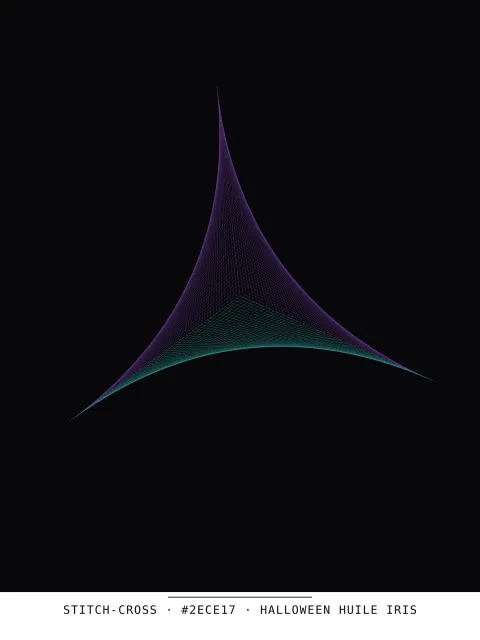
String art
No thread is curved. The curve is what all the threads draw together.
The rule
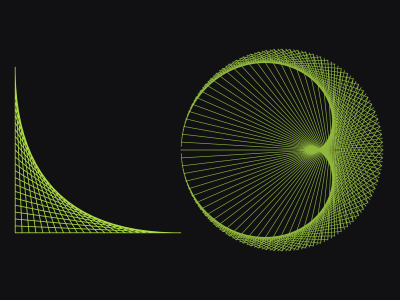
Around 1900, Mary Everest Boole taught geometry to children with cardboard, a needle and thread. No compass, no formula. Draw two lines that meet in a corner, mark each one from 0 to n starting at the corner, then join mark i on the first to mark n − i on the second:
thread i: from P + (i/n)(V − P) to V + (i/n)(Q − V)
Every thread is straight. And yet, once they are all stretched, a curve shows up in the corner: a parabola nobody drew. It is the envelope of the threads, the line they all graze without any of them following it.
Same idea on a circle: place n marks, and join mark k to mark m × k (start again from zero once you go round). It is a times table, stitched:
thread k: from mark k to mark (m × k) modulo n
With m = 2 you get a cardioid, a heart shape. With m = 3, a nephroid (the bright curve that settles at the bottom of a coffee cup in the sun, really). Still not one curved stroke, only segments!
Your turn
The schema opens on Boole's corner. The “Threads” slider sets how many you stretch: with four it is a scribble, with two hundred the parabola is sharp. Switch the figure to “Circle” and a second slider shows up, the multiplier m: 2 for the cardioid, 3 for the nephroid, and higher up it turns into a flower.
“One more thread” stitches one thread at a time, with the keyboard or the mouse: watch how many threads it takes before your eye sees the curve. “Play” stitches on its own, “Stitch all” finishes in one go.
Threads in place
The drawing above is a teaching sketch, not the artwork: it shows the rule, it does not replay the colours, the size of the dots or the grain of the print.
What changes from one algorithm to the next
All seven follow the same rule: only straight segments, and the curve is born from their envelope. The drawing is perfect (no shaky thread, no chance in the stroke): what changes is where the marks go and who gets joined to whom.
- Stitched Corners
- Boole's corner, placed at every vertex of a regular polygon. With several layers, a smaller polygon is stitched inside the previous one, turned by half a step, and the parabolas nest into each other.
- Stitched Circle
- The times table on the circle, the one from the toy. The multiplier picks the figure: cardioid, nephroid, then curves with three, four, five lobes.
- Boole's Cross
- Arms leave the centre, and every angle between two neighbouring arms is stitched like a corner, from the tip towards the centre. The parabolas turn their backs on each other and draw a star with as many points as arms.
- Stitched Star
- A star polygon (you join the vertices of a polygon while skipping a few), then Boole's corner stitched into every point. One parabola per point.
- Folded Ellipse
- Folding a paper disc: each mark on the rim is brought onto a fixed point inside, and each fold becomes a thread. All the folds graze an ellipse, which stays empty in the middle of the canvas: here, the curve is the hole.
- Stitched Whirl
- A polygon, then a second one whose vertices sit a little further along each side of the first, and so on, dozens of times. The vertices coil towards the centre in spirals (it is the mice problem, mice chasing each other).
- Stitched Epicycles
- The times table again, but between two circles: mark k on the big circle is joined to mark m × k on the small one. The threads draw rosettes, epicycloids, with an empty disc in the centre.
What chance decides
For each artwork, the program draws these settings at random, between bounds set in advance.
- Times-table multiplier Stitched Circle from 2 to 12
- Threads per corner Stitched Corners from 16 to 90
- Focus position Folded Ellipse from 0.1 to 0.9
The algorithms in this family
- Stitched Corners
- Stitched Circle
- Boole's Cross
- Stitched Star
- Folded Ellipse
- Stitched Whirl
- Stitched Epicycles