Strange attractors
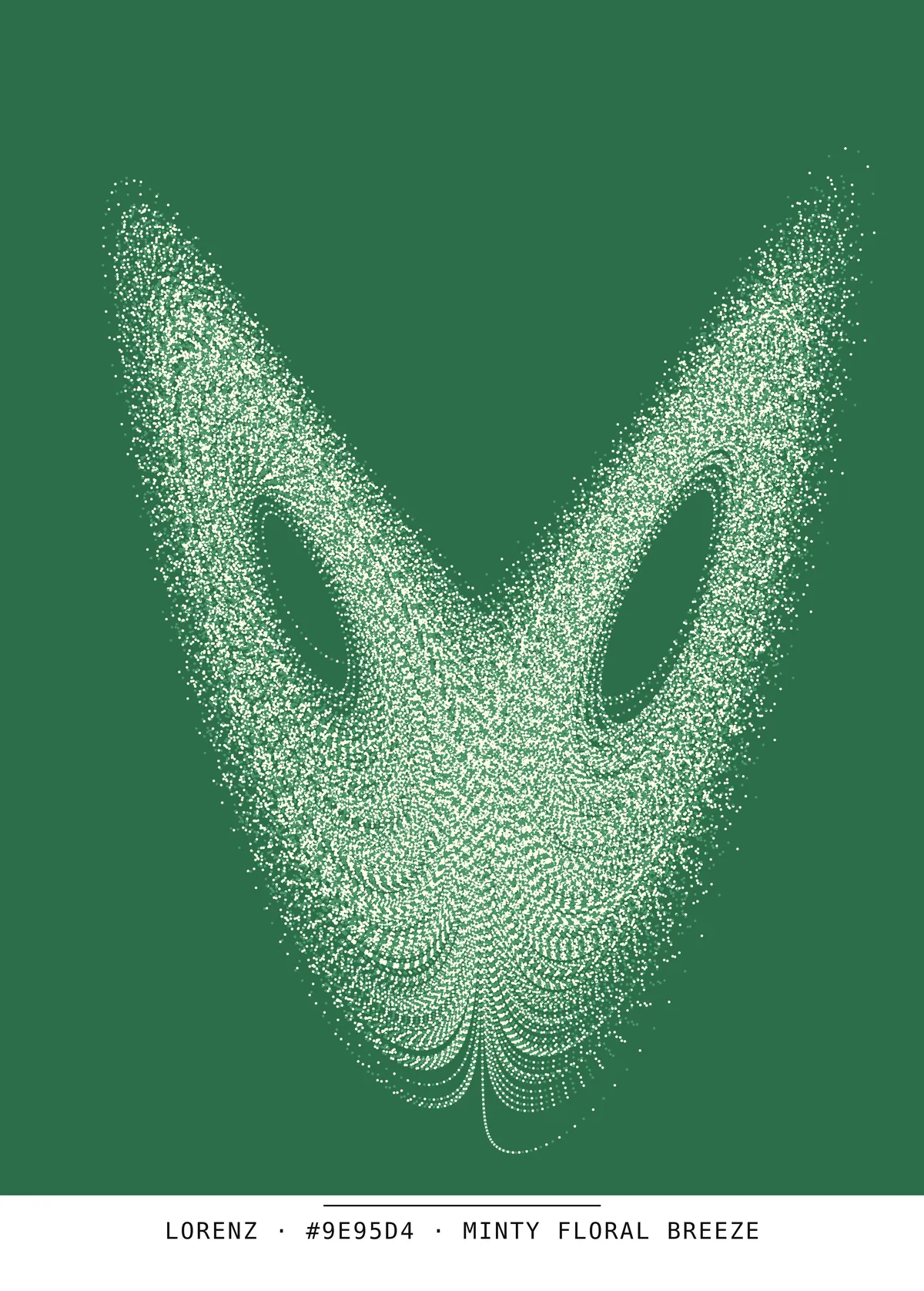
The same equation is repeated thousands of times and the trail of the point is kept.
The rule
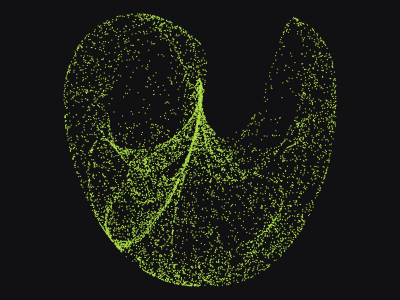
A strange attractor comes from an equation you repeat. You start from a point, apply the equation to find the next one, then start again, thousands of times. You only keep the trace of the points. Here is the De Jong map:
x' = sin(a·y) − cos(b·x)
y' = sin(c·x) − cos(d·y)
The four numbers a, b, c and d are enough to fix the shape. The equation has no randomness in it: same numbers, same cloud. But a tiny change in one of them moves many points, and the figure can go from lace to a plain cloud.
The Lorenz attractor follows the same idea, with time flowing continuously. Three equations give the speed of the point:
dx/dt = σ(y − x)
dy/dt = x(ρ − z) − y
dz/dt = xy − βz
We move forward in small steps to follow the trajectory, and we look at it face on, with x across and z up. It circles around two wings without ever passing twice through the same place.
Your turn
Move a and b: the cloud of 20,000 points is recomputed at every move of the slider and reframes itself. Look for the places where the figure suddenly flips.
The Lorenz button switches system. The trajectory draws itself little by little, like a pencil line, and ρ sets its look: around 28, you find the two wings again.
The drawing above is a teaching sketch, not the artwork: it shows the rule, it does not replay the colours, the size of the dots or the grain of the print.
What changes from one algorithm to the next
The family has two maps that are repeated and one system that flows continuously. None of the three uses chance while drawing: everything comes from the numbers chosen at the start.
- De Jong Attractor
- Peter de Jong's map, the one in the toy above. Four coefficients, a, b, c and d, fix the whole shape: a web of very fine threads.
- Clifford Attractor
- Clifford Pickover's map: x' = sin(a·y) + c·cos(a·x) and y' = sin(b·x) + d·cos(b·y). Same idea, but the figures are more like smooth sheets that curl up.
- Lorenz Attractor
- The Lorenz butterfly, from a convection model. It is no longer a map but a system of equations, followed step by step, then seen face on in the x-z plane. The classic values are σ = 10, ρ = 28 and β = 8/3, and the artworks make them vary slightly.
What chance decides
For each artwork, the program draws these settings at random, between bounds set in advance.
- Parameter a De Jong Attractor from -2.5 to 2.5
- Parameter b De Jong Attractor from -2.5 to 2.5
- Parameter rho Lorenz Attractor from 26 to 34
The algorithms in this family
- De Jong Attractor
- Clifford Attractor
- Lorenz Attractor