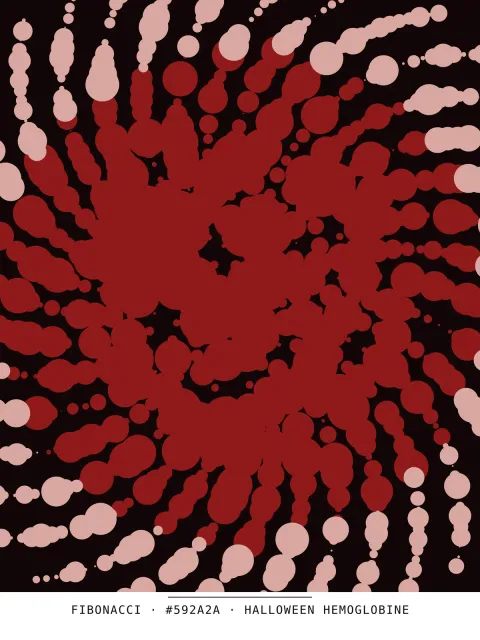
The golden ratio
Each point is placed after the previous one, with the same rotation. Everything depends on that angle.
The rule
Start from zero and one, then each number is the sum of the two before it.
0, 1, 1, 2, 3, 5, 8, 13, 21, 34…
Divide a number in the sequence by the one before it and the result slowly settles towards 1.618, the golden ratio. Cut a full turn of 360° into two parts whose ratio is that number: the smaller part is the golden angle, about 137.5°.
Your turn
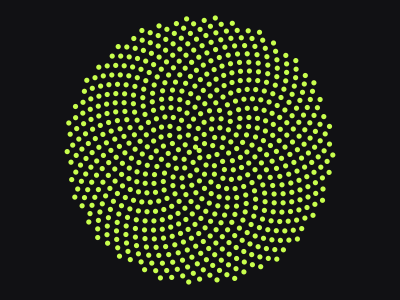
Points are placed one at a time, each a little further from the centre and turned by the same angle as the previous one. With 90° or 120° you get clean spokes. With the golden angle, a spiral appears and nobody drew it.
The angle slider has four notches: 90°, 120°, 137.36°, an angle close to the golden one like those the program draws at random, and the perfect golden angle.
The drawing above is a teaching sketch, not the artwork: it shows the rule, it does not replay the colours, the size of the dots or the grain of the print.
In nature
The sunflower packs its seeds this way. So do the romanesco, the pine cone and the pineapple. It is the most even way to fill a disc without ever overlapping two seeds.
The program does not copy nature. It applies the same rule, and lands in the same place.
What chance decides
For each artwork, the program draws these settings at random, between bounds set in advance.
- Angle between two points (°) Fibonacci from 136.8 to 138.2
- Number of points Fibonacci from 800 to 2,500
- Number of petals Fermat Rose from 3 to 9
The algorithms in this family
- Fibonacci
- Fermat Rose
- Shredded Fermat Rose